
Introduction
Low-code platforms allow enterprises to build and deploy applications significantly faster than traditional development approaches. However, as adoption grows across departments, organizations often face a new challenge: uncontrolled application development.
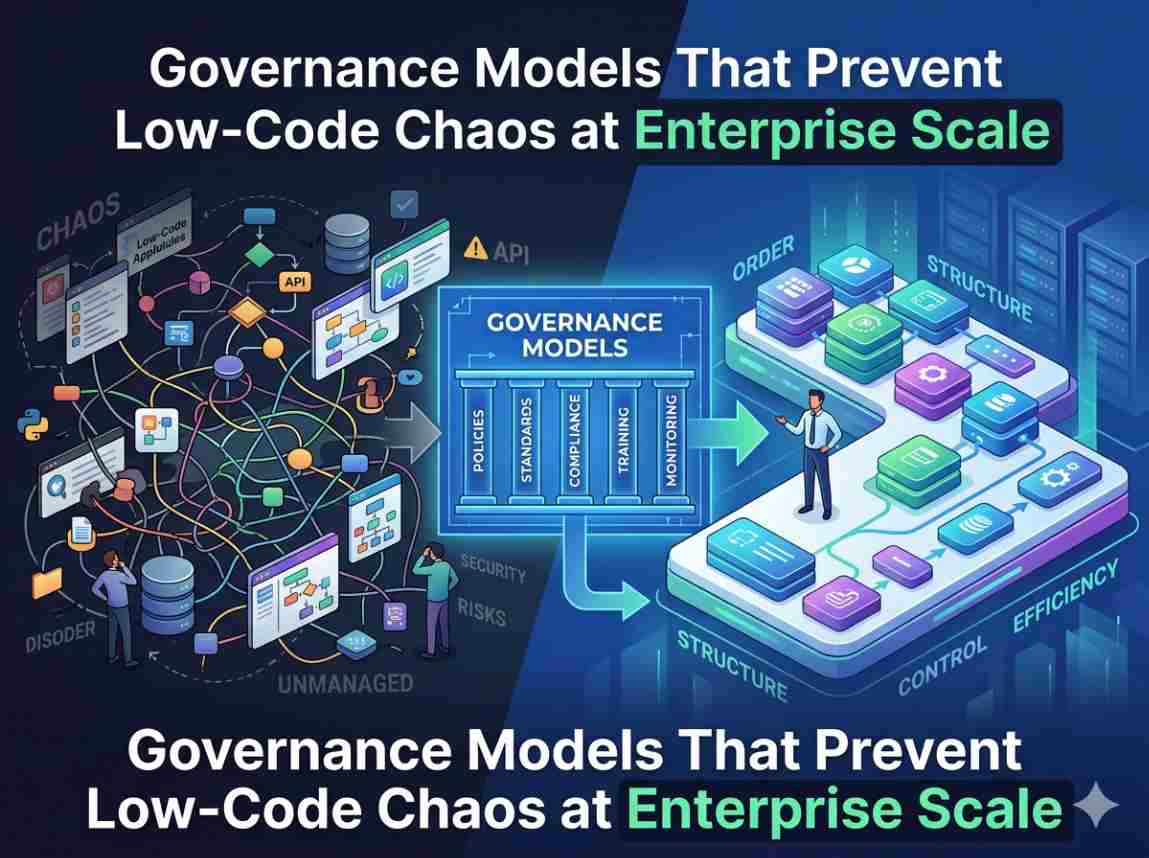
Without structured governance, low-code initiatives can quickly lead to application sprawl, inconsistent security practices, and fragmented data architectures. CIOs and enterprise architects must therefore implement governance frameworks that balance innovation with operational control.
A well-designed governance model ensures that low-code platforms enable rapid innovation while maintaining the standards required for enterprise-scale systems.
Why Governance Becomes Critical as Low-Code Adoption Grows
In many organizations, low-code platforms are initially introduced for a few internal applications. Over time, business teams recognize the benefits of rapid development and begin creating additional solutions for various operational needs.
While this expansion improves productivity, it also introduces several risks if governance is not in place.
Application Sprawl
Multiple departments may begin building applications independently, resulting in duplicate functionality, inconsistent design standards, and disconnected data environments.
Security and Compliance Risks
Applications built without centralized oversight may fail to follow enterprise security standards, creating potential vulnerabilities and compliance issues.
Integration Challenges
Applications that are developed without proper architecture planning often struggle to integrate with existing enterprise systems such as ERP platforms, CRM tools, or data warehouses.
These challenges highlight why governance is essential when scaling low-code platforms across large organizations.
The Foundation of Enterprise Low-Code Governance
Successful governance frameworks provide structure without limiting innovation. Enterprises typically design governance models that establish clear responsibilities, development standards, and architectural guidelines.
A balanced governance approach focuses on three critical elements:
- standardized development practices
- centralized architectural oversight
- collaboration between business and IT teams
When these elements are implemented effectively, organizations can scale low-code adoption while maintaining control over their application ecosystem.
The Role of a Low-Code Center of Excellence
Many enterprises establish a Low-Code Center of Excellence (CoE) to guide platform adoption and maintain governance across the organization.
The CoE typically includes enterprise architects, platform specialists, and governance leaders who define the standards used across all low-code applications.
Key responsibilities often include:
- defining development frameworks and architecture guidelines
- establishing security and compliance standards
- maintaining reusable components and templates
- supporting development teams across departments
By centralizing expertise, the CoE ensures that applications built across the organization remain consistent and scalable.
Establishing Clear Development Standards
Enterprise-scale low-code adoption requires clearly defined development standards that guide how applications are built, deployed, and maintained.
These standards typically address areas such as:
- API integration practices
- data management policies
- user authentication and access control
- application lifecycle management
Standardization helps development teams build applications that align with enterprise architecture while reducing technical debt over time.
Architecture Governance for Scalable Applications
Enterprise applications must interact with multiple systems across the organization. Governance models therefore include architectural guidelines that ensure applications remain scalable and well-integrated.
This includes defining how applications should interact with:
- enterprise APIs
- data platforms
- identity management systems
- cloud infrastructure
When architecture governance is implemented early, organizations avoid costly redesigns as applications grow in complexity.
Managing Innovation Without Losing Control
One of the most common concerns among CIOs is whether governance will slow down innovation. In reality, well-designed governance models enable innovation by providing a structured environment for development.
By defining reusable components, integration frameworks, and development templates, organizations allow teams to build applications faster while maintaining consistency.
This approach ensures that innovation happens within a secure and scalable framework rather than through isolated development efforts.
Integrating AI and Advanced Capabilities
As enterprises expand their digital capabilities, many applications now include advanced features such as automation, predictive analytics, and intelligent workflows.
Organizations implementing ai app development services often combine these capabilities with low-code platforms to build intelligent applications that integrate with enterprise data systems.
Governance frameworks ensure that these advanced solutions follow the same architecture and security standards used across the organization.
Platform Expertise and Implementation Strategy
Selecting the right platform and implementation strategy plays a critical role in maintaining governance at scale.
Enterprises building scalable digital solutions often rely on platforms that support enterprise architecture principles and strong governance frameworks. For example, organizations implementing Mendix SaaS development can build cloud-native applications that follow standardized architecture and lifecycle management practices.
This structured approach ensures that applications remain scalable while supporting continuous innovation.
Why Governance Requires the Right Implementation Partner
Governance frameworks are most effective when supported by experienced implementation partners who understand enterprise architecture and platform best practices.
Organizations often work with providers offering low code consulting services to design governance models, define architecture standards, and guide platform adoption across departments.
These partners help enterprises implement governance structures that enable innovation while preventing uncontrolled application growth.
Why Enterprises Choose We LowCode
At We LowCode, we help enterprises implement scalable governance frameworks that allow organizations to adopt low-code platforms without sacrificing architectural control.
Our team works closely with CIOs, enterprise architects, and digital transformation leaders to design development standards, integration frameworks, and lifecycle management strategies that support enterprise-scale applications.
By combining platform expertise with deep enterprise architecture knowledge, we enable organizations to expand their low-code ecosystems while maintaining security, governance, and long-term scalability.
Best Practices for Preventing Low-Code Chaos
Enterprises that successfully scale low-code platforms typically follow several best practices.
Establish Governance Early
Introducing governance frameworks at the beginning of platform adoption prevents application sprawl and ensures consistent development standards.
Maintain Centralized Architecture Oversight
Enterprise architects should guide how applications interact with core systems, ensuring that integration strategies remain consistent.
Promote Collaboration Between IT and Business Teams
Low-code platforms work best when development teams collaborate closely with business stakeholders to design applications aligned with operational needs.
Invest in Reusable Components
Reusable templates, modules, and integration frameworks help development teams build applications faster while maintaining architectural consistency.
Conclusion
Low-code platforms offer enterprises a powerful way to accelerate application development and drive digital transformation. However, scaling these platforms across large organizations requires strong governance frameworks.
By implementing structured governance models, enterprises can prevent application sprawl, maintain security standards, and ensure that low-code initiatives support long-term business objectives.
With the right governance strategy and experienced technology partners, organizations can scale low-code adoption confidently—transforming rapid development capabilities into sustainable enterprise innovation.
